2019年8月9日 星期五

Mstar Uber, DXC, Dropbox, Farfetch, Avnet, Uniti, Synaptics

Stock Analyst Notes
Uber, DXC, Dropbox, Farfetch, Avnet, Uniti, Synaptics
tab_bar
by Morningstar Equity Analysts | 8/9/2019 10:30:00 AM
 

While demand for  Uber's UBER services remains strong, the firm's second-quarter revenue came in a bit short of consensus expectations and losses were higher than expected due to the restricted stock unit expenses related to its IPO. However, in our view, there are some indications of possibly operating leverage as growth in users and rides was not accompanied by significantly higher operations, support, and marketing costs as a percentage of net revenue. Plus, excluding a one-time IPO-related award to drivers, take rates in the firm's core platform increased sequentially, which we think further displays ride share pri ce stability and a stronger online food delivery market position for Uber Eats. Management now expects net revenue growth to accelerate a bit during the remainder of 2019 driven mainly by growth in gross bookings. Based on second-quarter results, we slightly adjusted our 10-year model and are maintaining the $58 per share Uber fair value estimate. After surging more than 8% during market hours, the stock is down 6% in after-hours. This name requires some patience, but we remain confident that Uber, along with its peer, Lyft, are progressing toward profitability. We continue to recommend investing in this 4-star narrow-moat name.
Ali Mogharabi

 DXC Technology DXC reported a weak start to fiscal 2020 with the firm seeing currency headwinds, delays in closing deals, and greater-than-expected pressure in its traditional lines of business. Consequently, management lowered its fiscal 2020 guidance. For the year the firm now expects total revenue of $20.2 billion-$20.7 billion (down from $20.7 billion-$21.2 billion) and non-GAAP EPS of $7.00-$7.75 (down from $7.75-$8.50). DXC's result doesn't instill confidence and follows a tumultuous 12-months where industry rumors have spread about management turnover and general upheaval across the lower and upper ranks of the firm. We think the firm still has plenty of work to do to properly align its services portfolio with the growing digital transformation trends of its end markets . Its convoluted M&A history and grounding in legacy infrastructure services remain areas in need of attention. As a result, we continue to view the firm as the only no-moat IT services provider we cover. With shares falling sharply afterhours and hovering around $43 (implies a forward price to adjusted earnings ratio of 5.7 times), DXC is trading at a significant discount to our revised $88 fair value (down from $91). However, the company remains a high-risk investment. For the quarter, revenue fell 7.4% year over year to $4.9 billion (declined 4.2% in constant currency). For the entire note, click here.
Andrew Lange

 Dropbox DBX once again exceeded its revenue guidance, but compression in average revenue per user and a dip in profitability potentially signal longer-term issues for the company, sending shares lower afterhours. Management highlighted its transition to the new Dropbox, moving users from thinking of it as a "magic folder" for cloud storage to a "magic workplace" that changes how knowledge workers interact. We continue to believe that Dropbox is viewed by users as a commodity cloud file storage solution and that users will eventually churn to competitors like Microsoft and Google. We are maintaining our fair value estimate of $13 per share. Despite shares trading down on the report, we still do not view Dropbox's shares as attractive. Dropbox added another 400,000 paid us ers during the second quarter, bringing its total paid user base to 13.6 million. On pricing, average revenue per user decreased by less than 1% sequentially to $120.48. While ARPU is up nearly $4 year over year, our model assumes only a moderate amount of ARPU expansion over the next decade. The company pointed to currency headwinds and the timing of some large customer deals as factors behind weak ARPU. Total revenue for the quarter was $401.5 million, up 18% over the second quarter of 2018.  For the entire note, click here.
John Barrett

We are putting  Farfetch FTCH shares under review to assess the effect of the acquisition of New Guards Group on Farfetch's financials. We expect to publish our new fair value for shares on Aug. 12. 
Jelena Sokolova, CFA

Narrow-moat distributor  Avnet AVT announced mixed fourth quarter results as sales were within management's guidance range and adjusted earnings missed the low-end. Like its suppliers and peers, Avnet is the midst of difficult environment and one that we expect to continue for the next few quarters, as was captured in guidance for the upcoming period. As a result, and despite the benefit from time value of money in rolling our model, we are lowering our fair value estimate to $43 from $45. Total revenue in the second quarter was $4.7 billion roughly at the midpoint of prior guidance which represented a year over year decline of 7.5%. Both of Avnet's segments struggled during the quarter. Electronic components revenue declined by 7%, both on a year-over-year ba sis and sequentially, to $4.3 billion as growth in both Americas and Asia regions was offset by headwinds in Europe. At the end of the quarter, the book/bill in both Europe and Asia was below parity, leading to a total book/bill of 0.92. The inventory correction in the broad semiconductor market continues to impact Avnet, like its peer Arrow Electronics, and industrial and automotive demand in Europe and China remain areas of concern. Management did indicate signs of stabilization in Asia but did not go so far as to call the timing of any recovery. Farnell sales were also down during the quarter, sliding 12% year over year to $343 million. For the entire note, click here.
Seth Sherwood

 Uniti's UNIT second-quarter results were uneventful, falling in line with our expectations and confirming that Uniti continues pursuing its plan to grow its various infrastructure assets and leases. The reality is that the results and progress currently mean very little, as Uniti continues to collect the full amount of its Windstream lease payments while working to resolve the future of the lease within Windstream's restructuring. With Windstream currently making up nearly 85% of Uniti's EBITDA, quarterly fluctuations in the rest of its business have little impact on our fair value estimate. No news in the quarter affected our long-term view, so we are maintaining our $13 fair value estimate, which implies this very high-risk stock is undervalued. However, investors need to be awa re that our estimate is at the mercy of the Windstream resolution. We estimate the lease payments will be cut by 25% beginning in 2020, but no news has leaked that offers insight into what's most likely, and a wide range of outcomes is possible. The adjusted EBITDA margin contracted 150 basis points from last year's second quarter, and we estimate it would have contracted an additional 200 basis points but for and insurance recovery stemming from Hurricane Michael. Margin contraction is inevitable as Uniti broadens its offerings away from the triple-net leases like the one it has with Windstream. Those leases result in nearly 100% margin, so any mix shift away from those reduces companywide margin. For the entire note, click here.
Matthew Dolgin, CFA

 Synaptics SYNA reported mixed results, with profitability roughly on par with expectations and sales falling short of guidance. The firm announced Michael Hurlston as the new president and CEO earlier in the week and now with more stable leadership, we expect Synaptics to be on firmer footing to deliver on the market opportunities available. However, it is also clear that this will take time to be realized with macroeconomic uncertainty, trade bans, and technology transitions continuing to be difficult hazards to negotiate. We are consequently cutting our fair value estimate significantly to $40 per share from $55. Double-digit revenue declines are expected for 2020, and we reiterate our very high fair value uncertainty and no-moat ratings. Sales in the fourth quarter totaled $295 million which represented a decline of 24% year over year. PC sales were down 15% year over year and 9% sequentially to approximately $60 million. Sales into the Internet of Things segment, which includes automotive, smart-home, and other consumer electronics products, were up 21% sequentially to $76 million. While this still represented a year-over-year decline of 21%, design activity across a variety of products bodes well for growth in the end market for the fiscal year.Mobile sales declined by 29% year over year to $158 million, due to a combination of the Huawei ban and broader China headwinds. For the entire note, click here.
Seth Sherwood


2019年8月8日 星期四

Amazon seeking alpha

Valuating Amazon's Big Move Into Automotive Data Monetization

|
16 comments
|
 About: Amazon.com, Inc. (AMZN)Includes: AUDVFBMWYYGRABIBMLYFTMSFTOLACUBERVLKAFVWAGY
Summary

It is estimates that the overall revenue from car data monetization at a global scale could add up to USD 450 to 750 billion by 2030.

I believe that Amazon recognized this value early on and is addressing the need for a platform that meets the needs.

A very conservative calculation shows that Amazon's sales in the cloud will double solely as a result of automotive monetization.

The highly profitable cloud business is not at all affected by the antitrust concerns. This gives investors a lot of security with regard to possible interventions.


Introduction

Amazon (AMZN) is currently struggling with a lot of news about battles with competition authorities and disappointing quarterly results. I myself have spoken bearishly about the company several times. I'm still very skeptical about Amazon's dominant market position and the company's practices. For my scepticism about the economic network effects of the business model, I was often attacked by investors in the commentary section of my article. According to the quarterly figures, however, it suddenly appears as if the wind has turned.

Given that, one threat does not necessarily weigh as much as another threat. To evaluate the risk of an investment, Investors have to perform very thorough due diligence. In view of the current sentiment, I would like to point out a mega chance for Amazon that lies in the monetization of data in the automotive sector.

Amazon's Automotive Cloud

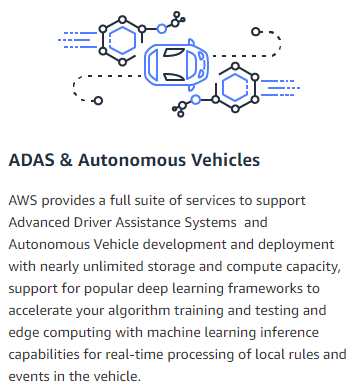
I have always explicitly excluded the cloud business from my negative scenarios in my former analyses. While other analysts are now also increasingly negative about the company and the high P/E ratio, it could be overlooked that the world continues to turn and that technical progress is also proceeding in favor of Amazon's cloud business. Hardly noticed by investors, something trend-setting has happened in Europe, which will appeal to a few companies. Amazon is one of them. In the following I will explain why this is the case. But first we should look at Amazon Automotive Cloud service. Amazon's cloud service AWS provides services for the Automotive industry to enable the digital transformation at every point of the value chain.
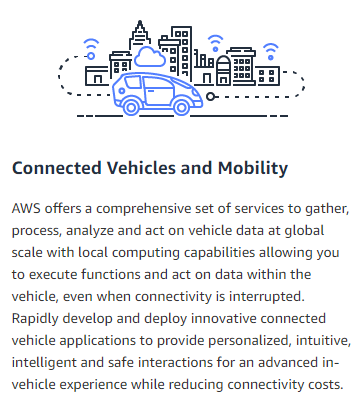

(Source: AWS for Automotive - Amazon Web Services)

Hardly noticed by investors, the EU member states stopped a new Wi-Fi standard for autonomous driving in the EU. The planned Wi-Fi standard was rejected by a qualified majority of 21 states. This sets the course for the 5G standard in Europe and shows that the time of talk is gradually over, and the implementation of the first 5G applications is now imminent. Amazon will benefit extremely from this, because now a political support of 5G applications is to be expected. Overall, I believe that Amazon recognized a mega trend early on and is addressing the need for a platform that meets the needs like no other company.

Assessment of value

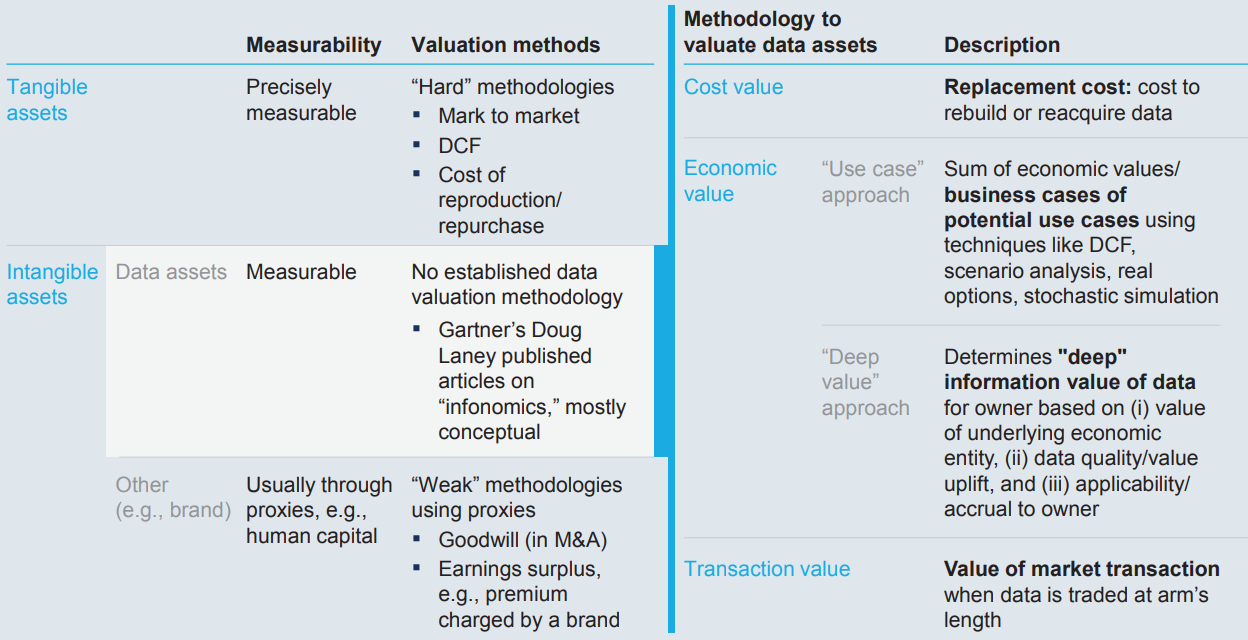
The future of automotive is determined not only by robotics and artificial intelligence, but also by connecting cars with their surrounding. V2X or the communication between vehicle and everything is a form of technology that allows vehicles to communicate with moving parts of the transport system. V2X consists of several components: Vehicle-to-Vehicle (V2V), Vehicle-to-Road (V2R), Vehicle-to-Infrastructure (V2I), Vehicle-to-Network (V2N) and Vehicle-to-Person (V2P). These connections generate an extremely large amount of data. One car alone generates 4,000 GB data in one day. This flood of data must of course have a value. Since data is a relatively new appearance of intangible assets, it is not always easy to calculate the value of data. There are essentially three approaches. You can determine the value of data once according to how expensive it is to create or reacquire it. Another methodology to valuate data assets is to sum op use cases via computations (discounted cash flow, stochastic simulation etc.). Furthermore, investors can assess the value of data assets by the transaction value of data trades.
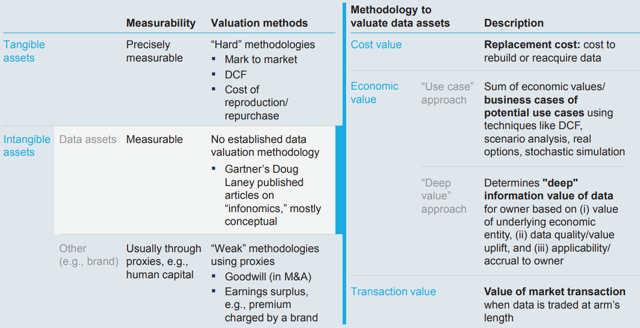
(Source: Valuation of data)

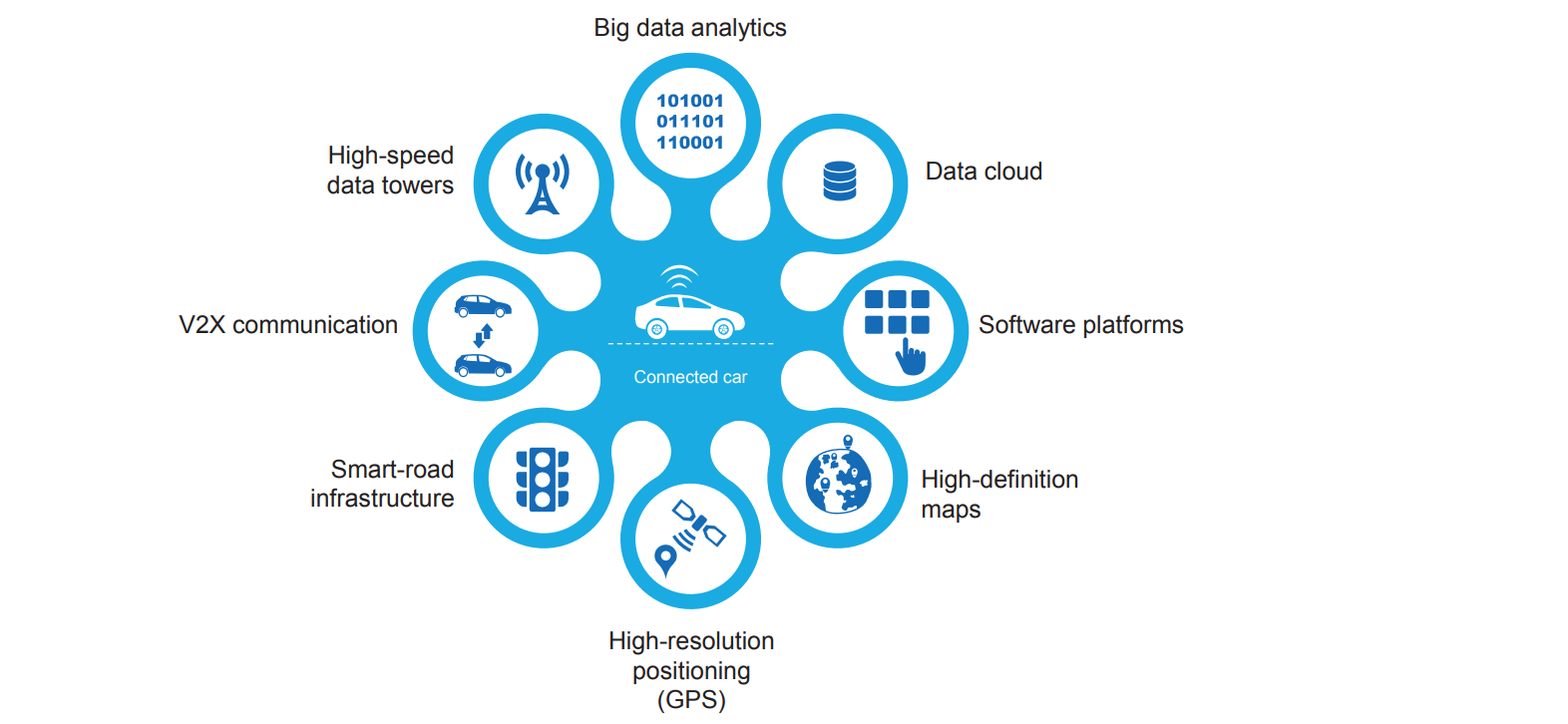
To see how valuable data will be in the automotive sector, just take a look at the technologies with which cars will be networked in the future. According to a study by McKinsey, eight different infrastructure technologies will enable car data monetization:
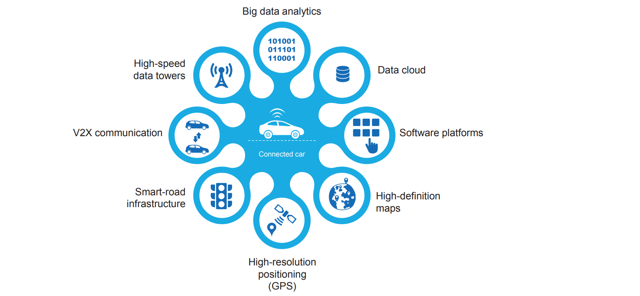
(Source: Key infrastructure technologies)

In accordance with the "use case" approach, it becomes clear here how many different application areas will create and use data in the automotive sector. This generates this extremely large amount of data of 4,0000 GB per day (each day, see above). This data must be managed, calculated and distributed. Furthermore, a system is required that allows the respective data subjects access to the data. Conversely, it must be ensured that unauthorized persons do not have access to the data. This is accompanied by the need for sufficient security mechanisms to protect the data against sabotage, falsification, theft and deletion. Of the key technologies, three aspects are particularly important for this area.

  • Data cloud: Connected cars generate a massive amount of date. To have access to these data, Data cloud acts as the remote repository.
  • Software platforms: This platforms will support the operating systems, app store, and payment systems of the car data infrastructure.
  • Big data analytics: To process the large amounts of data generated by connected cars on the road in real time big data analytics is required.

Given that it is estimates that the overall revenue from car data monetization at a global scale could add up to USD 450 to 750 billion by 2030, these three areas will occupy key positions as they are at the heart of car networking. This is where all the data obtained comes together, there are entries of data and exits of data. Hence, with the coming flood of data in autonomous vehicles will come a flood of money.

(Source: The coming flood of data)

Implication for Amazon

Amazon has positioned itself with regard to the three key technologies. With the cloud, it offers not only the possibility of storing data, but also analysis. The cloud also supports deep learning, which is particularly important in the area of autonomous driving. In addition to traditional car companies like BMW (OTCPK:BMWYY) and AUDI (OTCPK:AUDVF), Lyft (LYFT), Uber (UBER), Grab (GRAB) and Ola (OLAC) are all customers. So Amazon is already there where many providers still want to go. Volkswagen (OTCPK:VWAGYOTCPK:VLKAF), for example, is still working with Microsoft (MSFT) on its own cloud system.

In the last quarter, Amazon's cloud revenues grew 37.7 percent over the year to USD 8.38 billion (missing the analyst estimates of USD 8.5 billion slightly). What's really impressive is the margin. In the last quarter, Amazon's cloud business generated an operating income of USD 2.1 billion.

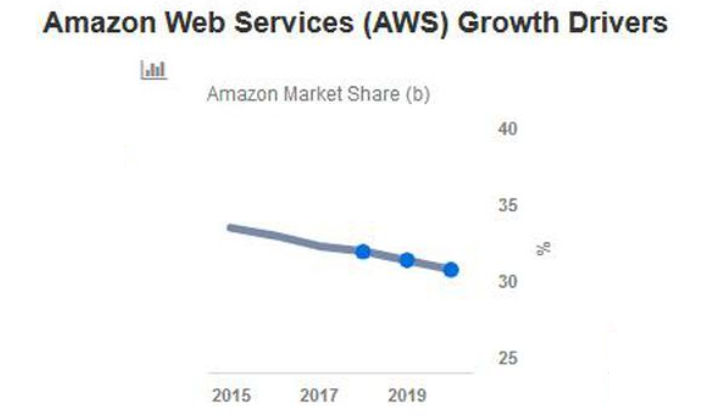
In order to make a qualitative statement about the financial opportunities, Amazon's market position is decisive. Over the last three years, Amazon's market shares have remained in the 32-33% range.
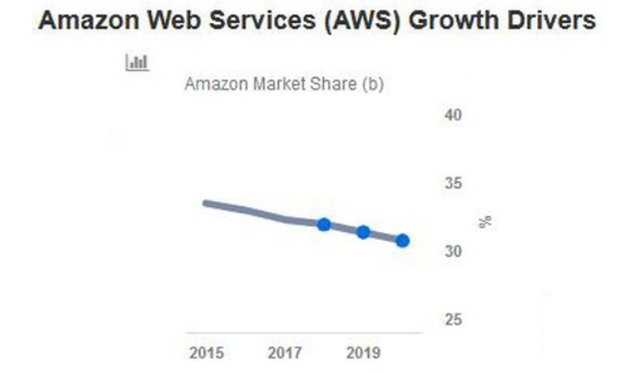
(Source: Amazon's market share in the relevant cloud market)

It should also be noted that Amazon is only active in some areas of Automotive data monetization (data cloud, software platforms and big data analytics). The expected revenue of up to 750 billion euros by 2030 will therefore cover more than these three areas. If one conservatively assumes a turnover of only 150 billion dollars per quarter in 2030, which is distributed evenly over the eight areas of data monetization described above, then the following calculation results for Amazon.

  • USD 150 billion / 8 = USD 18.75 billion per data monetization segment
  • USD 18.75 billion * 3 (Segments in which Amazon operates) = USD 56.3 billion
  • USD 56.3 billion * 30 % (market share) = USD 16.9 billion revenue per quarter

This conservative calculation shows that Amazon's sales in the cloud business will double solely as a result of automotive monetization in the next decade. If one takes the same margin as now, then the operating profit only from the automotive cloud segment would rise to USD 4.2 billion per quarter(!). This is inconceivable from the current point of view, but shows the potential of this mega market. So if Amazon can maintain its market share, investors in the cloud business are facing golden times.

Taking regulatory risks into account for Amazon

Personally, I consider the possibility of regulatory measures against Amazon to be quite high, regardless of whether I consider them to be right and reasonable or not. Nevertheless, I have a pretty concrete approach to such threats. Given that one threat does not necessarily weigh as much as another threat, investors have to perform very thorough due diligence. The decisive factors are the business models and how these business models would react to antitrust regulation. When it comes to the investigation of the European Commission, a fine is possible. However, this fine will only be a one-time charge. A fine will considerably hurt the profit for one year, but beyond that, it will have no further effect. As far as the FTC, DoJ and German Federal Cartel Office investigations are concerned, I still believe that Amazon's business model is relatively susceptible to regulatory intervention. This is due to the fact that Amazon's success and all of today's business (except the cloud business) is built on economic network effects: The more customers make purchases on Amazon, the greater the incentive for third-party sellers to also use Amazon as a platform. This attracts even more customers and gives Amazon the power to establish new services etc. I see a danger that regulatory measures could lead users to turn away from Amazon. The same effects that led to Amazon's growth would therefore be reversed.

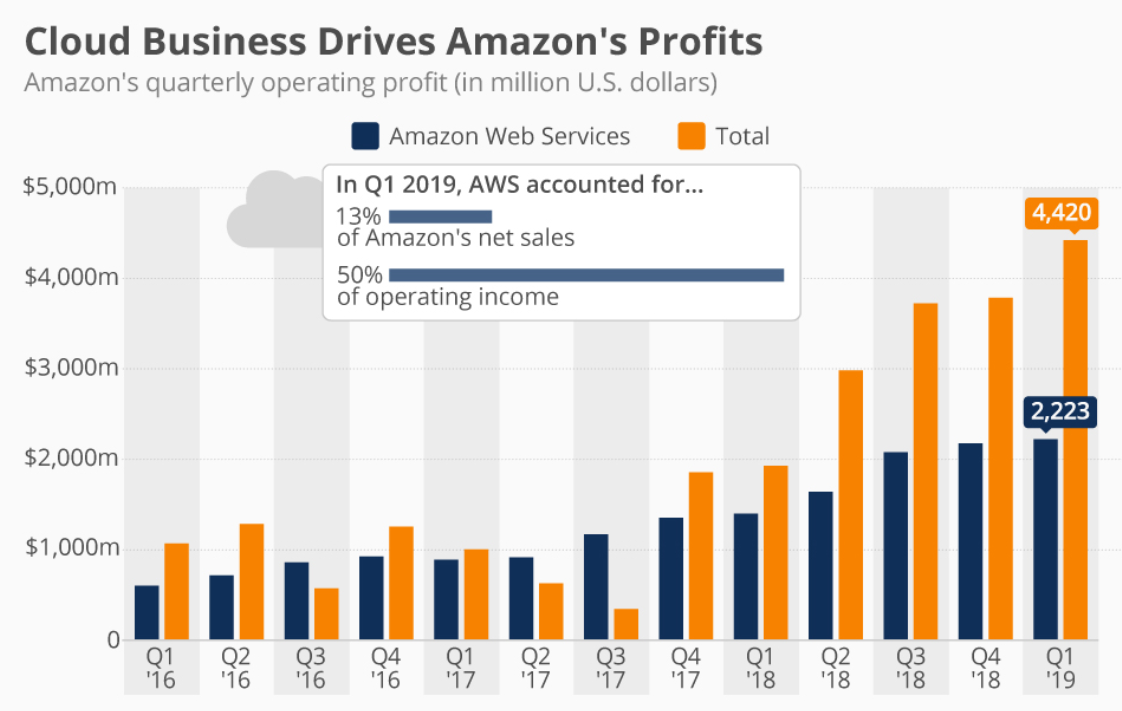
With regard to the cloud, however, this view should be put into perspective. As the following chart illustrates, Amazon's profit has largely been driven by its cloud business in recent years. Amazon Web Services (AWS), the leader in the highly competitive market for cloud infrastructure, accounted for more than 50 percent of the company's operating profit in the past quarter, despite contributing only 13 percent to the company's net sales.
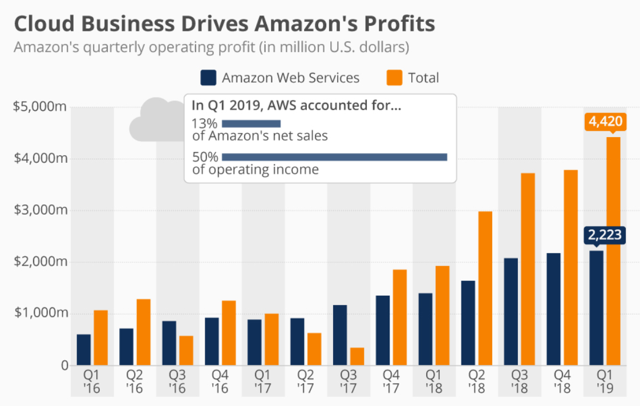
(Source: Cloud Business Drives Amazon's Profits)

This highly profitable area is not at all affected by the antitrust concerns. This gives investors a lot of security with regard to possible interventions. Does this development justify such a high P/E ratio? I don't know. The market thinks that this is the case and the market is usually smarter than the individual investor. In any case, this analysis shows that Amazon knows how to position itself prematurely in future mega trends. It could well be that in future the cloud business will also make up the largest part of the business in terms of net sales. From this perspective, fears of regulatory intervention in the rest of the business could fade.

Investors Takeaway

The investor's key takeaway is that the time of talk is gradually over, and the implementation of the first 5G applications is now imminent. The automotive sector will have a significant share in this mega market and will make up an important part of the market volume. Amazon has already positioned itself in this mega future market and has strong partners at its side. Furthermore, the highly profitable cloud business is not at all affected by the antitrust concerns. This gives investors a lot of security with regard to possible interventions.

If you enjoyed this article and wish to receive updates on my latest research, click "Follow" next to my name at the top of this article and check "Get email alerts".

Disclosure: I/we have no positions in any stocks mentioned, and no plans to initiate any positions within the next 72 hours. I wrote this article myself, and it expresses my own opinions. I am not receiving compensation for it (other than from Seeking Alpha). I have no business relationship with any company whose stock is mentioned in this article.

Editor's Note: This article discusses one or more securities that do not trade on a major U.S. exchange. Please be aware of the risks associated with these stocks.

Amazon comment

As Amazon's Business Evolves, Its Dynamic Long-Term Cash Flow Story Becomes More Apparent
R.J. Hottovy
Sector Strategist
Business Strategy and Outlook | by R.J. Hottovy Updated Jul 31, 2019

Amazon's disruption of the retail industry is well documented, but the company continues to find ways to evolve its business model. Its operational efficiency, network effect, and a brand intangible asset built on customer service provide its marketplaces with sustainable competitive advantages that few, if any, traditional retailers can match. The combination of competitive pricing, unparalleled logistics capabilities and speed, and high-level customer service makes Amazon an increasingly vital distribution channel for consumer brands. Even with more retailers looking to expand online, we believe Amazon will maintain its consumer proposition through Prime expedited shipping, an expanding digital content library, and new partnerships from its Whole Foods acquisition. Aided by more than 450 million estimated global active users, more than 130 million global Prime members, and fulfillment infrastructure, technology, and content investments, Amazon owns one of the wider economic moats in the consumer sector and is likely to reshape retail, digital media, enterprise software, and other categories for years to come.

Key top-line metrics--including active users (a 12% compound annual growth rate the past five years), total physical and digital units sold (23% CAGR), and third-party units sold (30% CAGR)--continue to outpace global e-commerce trends, suggesting that Amazon is gaining share while fortifying its network effect. On top of its impressive growth, Amazon is building a more visible margin expansion story despite investment requirements for new fulfillment infrastructure/capacity, content deals, AmazonFresh, hardware such as the Echo/Alexa-enabled products, new delivery technologies, and physical store expansion. While some capital decisions haven't always yielded strong returns, we're optimistic that Amazon can grow to and sustain 9%-10% operating margins by 2023 based on Prime adoption and new pricing tiers, new subscription services across multiple categories, AWS segment margins around 35%, fulfillment center scale, new third-party seller services, expanded advertising offerings, and Alexa technology licensing arrangements.

Economic Moat | by R.J. Hottovy Updated Jul 31, 2019

The traditional brick-and-mortar retail industry is undergoing a rapid transformation, particularly in commoditized categories. With nonexistent customer switching costs and intense competition, we've already seen Circuit City, Linens 'n Things, Borders, and RadioShack exit the retail landscape, while Barnes & Noble, Sears, office superstores, and a host of other retailers struggle to reverse deteriorating fundamentals. Market consolidation among mass merchants like Walmart and Costco has played a role in this trend, as have direct-to-consumer investments by key manufacturers. However, we view Amazon as the most disruptive force affecting the retail category over the past several decades. Its operational efficiency, network effect, and laser focus on customer service provide its marketplaces with sustainable competitive advantages that traditional retailers cannot match; this should yield additional market share gains in the years to come. Despite ongoing fulfillment, technology (hardware devices, Alexa, and AWS), and content investments, we expect Amazon can generate economic returns ahead of our cost of capital assumption over an extended horizon, supporting our wide moat rating.

One of Amazon's key advantages is its operational efficiency of its fulfillment and distribution network, which satisfies consumer demand for free and expedited shipping (including plans to expand one-day delivery for U.S. Prime members during 2019). This allows Amazon to generate strong cash flow, which in turn can be reinvested in advertising, customer service, and website enhancements that keep its marketplace robust and customer loyalty strong. In fact, we believe Amazon's brand has come to represent low prices, a wide selection, convenience, and superior customer service--a rare combination among retailers.

Amazon also benefits from a network effect, as low prices, an expansive breadth of products, and a user-friendly interface attract millions of customers, which in return attract merchants of all kinds to Amazon.com, including third-party sellers on Amazon's Marketplace platform (which represented more than 50% of total units sold in 2018) and wholesalers/manufacturers selling directly to Amazon. According to our research, the percentage of traffic to Amazon derived from search has fallen in recent years at a time when other online retailers have become more dependent on search. We think this indicates that Amazon is increasingly becoming the starting point for online purchases, akin to a mall anchor tenant. Additionally, customer reviews, product recommendations, and wish lists increase in relevance as more consumers and products are added to the Amazon platform, enhancing its network effect.

Amazon's $13.7 billion acquisition of Whole Foods in 2017 marks its most significant push into the grocery category but likely left some investors scratching their heads after more than two decades of building an e-commerce empire without physical stores. While we had expected the company to further test its other grocery concepts before going all in with physical stores, we do see several reasons this acquisition is more than just a push into the grocery category and can enhance Amazon's wide moat. First, there is already a high degree of overlap between Amazon Prime members and Whole Foods shoppers, with opportunities to migrate Prime members to the Fresh member tier (which presently runs $14.99 per month in addition to annual Prime membership fees, though we suspect changes to Fresh will continue as Whole Foods is further integrated). Second, Amazon adds instant credibility in fresh produce and proteins through Whole Foods' supplier base, something that had been slow to materialize with Amazon's grocery efforts to this point. On top of the company becoming a reputable player in fresh food, we expect that many Whole Foods suppliers will explore Amazon as a potential distribution channel, at least those not already using Amazon's marketplaces. Third, Amazon has a new vehicle to meaningful expand and accelerate its private-label offerings, including its own packaged food and household product private labels such as Happy Belly, Bloom Street, Mama Bear, and Wickedly Prime as well as the opportunity to sell Whole Foods' 365 label to existing Prime customers. Finally, Whole Foods' physical locations offer an opportunity to showcase new Amazon products and technologies.

We like Amazon's ability to compete in digital media, given its sizable customer base, the symbiotic hardware/software ecosystem of its Kindle, Fire TV, Dash, and Echo products, and intriguing licensing possibilities with Amazon's Echo and other Alexa-enabled voice-recognition products. We still view the Kindle suite of products as customer-acquisition tools that add multiple layers of upside to our base-case assumptions, including additional Prime memberships and engagement levels, accelerating digital media sales, and a positive halo effect on general merchandise sales. We believe Amazon will continue to develop into a formidable player in digital media, given its vast content offerings, inroads into new verticals (including video games), and ability to sell hardware as a loss leader.

We believe Amazon Web Services has similarly developed cost advantage, intangible asset, and network effect moat sources. Amazon's public cloud computing offerings possess more than 3 times the computing capacity in use than the next 10 largest providers combined (based on our estimates), providing the company with scale advantages and often making it the preferred name for corporations looking to reduce information technology expenditures. We expect AWS to generate $36 billion in revenue during 2019, and we forecast average annual revenue growth of 30% over the next five years. With recent investments in additional capacity and other innovations, we expect AWS to become an increasingly positive gross margin contributor--the segment posted a 28.4% segment operating margin in 2018, and we believe it can deliver mid-30s operating margins over a longer horizon--because of its highly scalable nature and other mission-critical services outside of cloud storage, as well as a network of third-party software providers selling on AWS Marketplace.

Fair Value and Profit Drivers | by R.J. Hottovy Updated Jul 31, 2019

Our fair value estimate is $2,300 per share following Amazon's second-quarter update, as we believe the emergent avenues of growth such as advertising, subscription services, international retail, and Alexa (and the future licensing opportunities it presents) will negate Prime one-day shipping investments. In Amazon's case, we do not believe traditional price/earnings and enterprise value/EBITDA metrics are meaningful, given the impact that technology, content, and infrastructure investments are expected to have on near-term margins. Still, we believe Amazon warrants a premium valuation based on its wide economic moat, meaningful avenues for growth, and longer-term margin expansion potential.

Amazon's competitive position and compelling value proposition should lead to additional share gains in 2019, putting full-year revenue growth around 19%. Our model assumes average annual revenue growth of around 16% for the five years ending 2023 due to contribution from physical retail formats, greater engagement among Amazon Prime members, and increased third-party sales from its suppliers, digital content sales, international expansion, and nascent growth channels like advertising and technology licensing. With respect to Amazon's sales mix, we forecast online retail revenue to grow 9% annually over the next five years--below our forecast of low-double-digit global industry growth over the same period, but partly a byproduct of Amazon's shift to a third-party marketplace--with smaller segments like physical stores, third-party seller services, subscription services, AWS, and advertising growing 6% (on a pro forma basis), 19%, 27%, 30%, and 31%, respectively, over the same period.

We forecast that gross margins will reach 43% over the next five years, compared with 40.2% in 2018. Amazon's growing clout with suppliers and advertisers, the higher proportion of third-party units in the sales mix, AWS' increased presence, and new advertising service offerings should allow for higher gross margins. We also forecast operating margin expansion through increasing expense leverage (particularly in the marketing and general & administrative expense line items), contribution from AWS, and accelerating third-party unit sales. Our model calls for Amazon to reach 9%-10% GAAP operating margins over the next five years, based on its strong competitive positions in AWS and North American e-commerce, as well as early indications of success in certain international markets.

Risk and Uncertainty | by R.J. Hottovy Updated Jul 31, 2019

Despite its leading position in a North American and European e-commerce industry with secular tailwinds, Amazon faces several potential risks. Impairment to Amazon's low-price positioning, whether real or perceived, could have an adverse impact on fundamentals. Amazon must maintain its value proposition and logistics efficiency to drive site traffic while competing with other merchants for market share. This includes managing the Amazon Prime fees--including increases to the base U.S. annual membership fee from $119--but we believe the convenience of the platform's fulfillment capabilities, expanded digital content offerings, and new subscription and streaming offerings will continue to drive new Prime membership growth and keep churn to a minimum. Other execution risks include exposure to volatile discretionary spending patterns and expansion into peripheral business lines and physical stores (including the integration of Whole Foods), which could distract management or lead to poor capital-allocation decisions. International growth brings unique regulatory challenges, as foreign governing bodies are constantly amending online commerce laws, often to the benefit of local players.

On top of execution risk, we see three other sources of potential risk: (1) regulatory, including the treat of increased shipping fees from the U.S. Postal Service or other regulated carriers, higher taxes, or antitrust investigations by the Justice Department; (2) direct and indirect competition from other retailers or technology firms; and (3) intangible asset impairment, including data breaches or concerns over inappropriate data usage or consumer fatigue. On the other hand, we see sources of upside risks from more diversified and specialized AWS offerings, expanded Fulfilment by Amazon capabilities, the rollout of AmazonFresh across additional urban centers, new potential pricing tiers or add-on features for Amazon Prime memberships, and expanding advertising to new channels.

Stewardship | by R.J. Hottovy Updated Jul 31, 2019

Chairman and CEO Jeff Bezos founded Amazon.com in 1994. We view Amazon's management team as Exemplary in terms of corporate stewardship. Bezos owns about 15% of the shares (and voting rights for 20%), takes no equity compensation or bonus pay, and collects a paltry salary. Although the board is small, it is elected every year, receives no cash compensation, avoids insider relationships, and hasn't implemented antitakeover provisions. The company also provides a fair amount of supplementary financial data in its financial reports. Our only complaint is that specific disclosures have not increased as the company has expanded into new areas, including digital downloads, the Kindle suite of products, and user/Prime membership data (though to its credit, management broke out AWS as a separate business unit in the first quarter of 2015 and disclosed that the company surpassed 100 million Prime memberships globally in 2017).

Amazon has made several investments in sustaining its moatworthy business models, including its global fulfillment infrastructure, a vast portfolio of audio and video content, and Amazon Web Services capacity. However, charges tied to the Fire Phone in 2014 and operating losses internationally underscore the importance of Amazon being selective with its capital-allocation decisions. We believe the lack of consumer interest in the Fire Phone was a wakeup call for management's future capital decisions, as the company runs the risk of losing key personnel without stronger returns on invested capital, owing to the equity component of many employees' compensation structure. However, we're comfortable with this risk, based on recent capital discipline and investments that have been more directly aligned with the core commerce marketplace and AWS platforms.


Fedex comment

Shares Still Cheap After We Reduced FedEx's FVE Due to Pension Underfundedness
Keith Schoonmaker
Sector Director
Business Strategy and Outlook | by Keith SchoonmakerUpdated Jul 11, 2019

Express pioneer FedEx continues to refine its portfolio to increase margins and capture a greater share of global trade. Well known for overnight parcel deliveries, FedEx has improved its competitive advantage by building the capacity to handle additional modes of shipping. After purchasing assets in ground delivery and less-than-truckload freight (both domestic U.S. operations) and expanding its asset-light air and ocean forwarding network, FedEx can now handle most shipping modes. Fulfilling more of its customers' needs makes FedEx more difficult to displace and a bigger, stickier part of clients' operations. The firm is also expanding its ability to serve intra-Europe shipments.

FedEx's extensive international shipping network would be difficult and costly to duplicate, giving the company a narrow economic moat. The strength of FedEx's barriers to entry was on full display when competitor DHL left the domestic U.S. parcel delivery market in 2009 after it determined the incumbent duopoly was too powerful to challenge without extended losses. We expect FedEx to exploit its competitive advantages, despite the challenges of global economic cycles and even some shippers (like Amazon) performing their own fulfillment.

The TNT Express acquisition gives FedEx the opportunity to operate and improve ground operations in Europe, where we believe online fulfillment has room to grow. However, we are skeptical that it can replicate the margins there that the U.S. ground system earns, because of the flexible cost structure of the U.S. independent contractor model.

We expect mix shifts to boost returns on invested capital as the firm expands high-ROIC ground operations and reaps the rewards of improving express profitability over five years. In response to weak international priority volume and growth of lower-yield international economy shipments, the firm realigned its fleet to better match demand and reduce costs. In fiscal 2018, the express segment (including TNT) produced about 55% of total sales and 45% of operating income; the higher-margin ground operation generated about 46% of total operating profit on just 28% of total sales.

Economic Moat | by Keith Schoonmaker Updated Jul 11, 2019

We identify three sources of economic moat for FedEx: cost advantage, efficient scale, and network effect. Three giants (FedEx, UPS, and DHL) dominate global parcel shipping, and the networks these firms have erected constitute formidable barriers to entry. We believe no firm will try to replicate a global shipping network anytime soon, given the large financial losses one would incur while trying to develop adequate volume to cover the high fixed costs of such a system.

In private U.S. domestic parcel shipping, FedEx is one of only two titans, and rational pricing has been the result. We don't anticipate this will change, even as the U.S. Postal Service captures a significant portion of the rapidly growing e-commerce shipping business. In replicating a network of planes, trucks, sorting sites, rights to fly, and skilled employees, a new entrant would need to use extensive resources before it could win a critical volume of customers from the entrenched strong brands. Even after massive investment, competitor DHL lost nearly $1 billion on U.S. operations in 2007. Facing larger losses because of soft volume during 2008 and beyond, DHL finally quit after a decade of trying to establish its U.S. domestic express delivery business. We consider this to be a textbook example of the power of an efficient-scale economic moat: a worthy competitor foiled by steep barriers to entry erected by the incumbent domestic U.S. integrated shippers. In this high-fixed-cost business, the substantial parcel volume handled by the incumbents provides a cost advantage that makes competing at market prices difficult for low-volume entrants.

The firm's foray into freight forwarding opens a network effect moat source because each additional office in this business makes the rest of the system more valuable to shippers. We also like this business for diversifying away from such asset intensity present in the rest of the company.

Despite the industry's barriers to entry, we constrain FedEx's economic moat rating to narrow rather than wide because we expect the firm to outearn its cost of capital by a slim margin--this tempers our confidence that the firm will reliably exceed its cost of capital two decades from now. We consider two of FedEx's reporting segments to have economic moats: air express and ground shipping operations, But its less-than-truckload freight shipping business (the largest LTL operation in the U.S.) earns low margins subject to economic cycles in part because customers have many alternatives, which drives down pricing. In freight, customer switching costs are low and many truckers can provide adequate service, leaving little opportunity to differentiate the firm's offerings.

Fair Value and Profit Drivers | by Keith SchoonmakerUpdated Jul 22, 2019

We reduced our fair value estimate to $190 per share from $197 as we incorporate the actual annual pension underfundedness reported in the Form 10-K. When the firm recently reported its fiscal fourth-quarter results, we reduced ground margins due to increased residential deliveries and the greater cost of fewer packages per stop. We still have confidence in FedEx's ability to invest capital and engineering expertise in TNT to improve these historically undersupported assets, but mix shifts and a slowing European economy can constrain the pace of such improvements.

Our assumption for medium-term capital expenditure as a percentage of revenue is 7%, as the firm continues to invest in TNT improvements, ground automation, and capacity. However, by fiscal 2023 express refleeting of expensive 767 and 777 aircraft should be completed; thus our expectation of a decline from the recent levels of capital expenditures at 8% of sales.

We expect FedEx to increase consolidated organic revenue by about 5% per year on average going forward, via both greater volumes and slightly increased rates. Our revenue projections assume ground sales grow at about 7% annually, based on organic growth (including from e-commerce shipments), with margins likely to remain the highest of any sector (14% midcycle). We project long-term midcycle EBIT margins at the express (including TNT) and freight segments to average 7.5% and 7.0%, respectively. These estimates produce consolidated operating margins of about 8%.

Risk and Uncertainty | by Keith Schoonmaker Updated Jul 11, 2019

FedEx is chiefly exposed to the health of the U.S. and global economies. As FedEx expands operations in Europe and Asia, continuing success depends not only on busy, healthy domestic and global economies, but also on continued stable conditions in these regions. Domestically, in nearly all states the firm immunized itself from the risk that ground drivers, who are currently contractors, may seek to become classified as employees by moving ground route owners to a multiple-route-owning independent contractor model. We think freight operations could organize more easily, although only a few terminals have voted to join the Teamsters and multiple terminals in the past few years have voted against joining the union. Currently in FedEx's U.S. operations, only express pilots are in a collective bargaining agreement, but on a global basis other employees are unionized, and this increased substantially with the TNT acquisition. While the current work arrangements pose little problem for FedEx, more widespread unionization, such as among express drivers, could reduce FedEx's ability to flex shipping capacity to match demand. In the U.S., however, the systemwide vote required by the Railway Labor Act presents a threshold for unionization greater than if express could organize into locals. The TNT Express acquisition was completed in 2016, and integration is still underway; FedEx will also need to contend with European unions as it works to improve TNT's lagging margins.

Stewardship | by Keith Schoonmaker Updated Jun 22, 2019

Fred Smith, FedEx's founder and the pioneer of overnight national delivery, remains at the helm of a largely independent board that has guided the firm through years of growth and profitability. As chairman, president, and CEO, Smith received $16.7 million in total compensation in fiscal 2018, principally via $1.3 million in salary, $7.1 million in option awards, and $7.7 million in nonequity incentive plan compensation. Smith's compensation in fiscal 2016 and 2017 was approximately $16.8 million and $15.6 million, respectively. FedEx cut costs in 2009, including reducing Smith's base salary 20%, lowering named executive base pay 10%, and freezing merit increases across the company. In fiscal 2018, FedEx paid four additional named executive officers between $6.0 million and $8.2 million in total compensation including increased actuarial value of pension plans. We think Smith's option awards and material equity position--about 8% of total outstanding FedEx shares--align his interests with other shareholders'. Smith is 74, but the firm's mandatory board retirement at 75 years of age applies only to nonmanagement directors. For years, Smith has said officers including himself have two backups, just like in his Marine Corps training, but the plan has not been shared externally.

Raj Subramaniam became president and COO on March 1, following COO David Bronczek's retirement. He has worked for FedEx for 27 years, including in multiple executive leadership roles and in several geographic regions. Several segment heads are new to their role, but in general they boast long FedEx tenure. Freight CEO John Smith assumed his role in mid-2018, and the firm appointed Henry Maier as CEO of ground in 2013. On the other hand, Alan Graf has served as CFO since 1998 and was CFO of express before that. While Bronczek was a strong leader and had worked for FedEx since its early days, we are not concerned about Subramaniam's appointment--he's already a proven FedEx leader.

As an example of responsible capital deployment, we believe the firm's patience in bidding for TNT Express was rewarded when, in early 2015, the euro weakened such that FedEx's price in dollars was dramatically lower than what it would have been just a year earlier, when UPS was attempting to purchase TNT. Clearly, the TNT operations needed investment of capital and expertise, perhaps more than FedEx anticipated before owning the business. Overall, we believe FedEx acts in the best interests of shareholders, and we consider its governance to be solid, in line with that of other large-cap transport and industrial companies.

2018年6月1日 星期五

为什么说盒马鲜生是中国的Costco?(分享自万得股票)

为什么说盒马鲜生是中国的Costco?
2018-05-18 19:23:40
(null)

分享自万得股票
您还可以通过新浪微博@Wind资讯浏览更多资讯


從我的 iPhone 傳送